
— GDPR Marketing Consent.
- 3 million customers. £millions at risk.
- 3-month deadline.
- Yielded £millions in extra yearly profit.
- Client
- Sky Betting & Gaming

01/ Summary

Some of the details in this case study may be vague to protect the client's sensitive information, such as financial details or customer numbers.
- — Services
- Behavioural insight
- Remote user testing
- Large scale user testing
- Development
- Google Analytics integration
- GDPR consultation
- — Deliverables
- 5 design iterations
- 5 HTML prototypes
- User-testing report
- Marketing consent resport
- — Outcomes
5 HTML prototypes and multiple rounds of user testing gave us a confident design to lead with. In live the design performed well and gave millions of pounds in extra yearly profit.
02/ Understanding the problem
GDPR storm approaching
It'll have been hard for you to have missed the word "GDPR". It was extremely prevalent in 2017 and 2018 as the May deadline approached, and then surpassed. GDPR or General Data Protection Regulation was a change in European law affecting the United Kingdom and thus Sky Betting & Gaming. It meant the way that data was stored and transferred was going to change. Consent and awareness of how your data was being used was also a huge focus of the new law change.
What did it mean for Sky Betting & Gaming?
It was the end of 2017 and the GDPR law change was looming. I had around 3 months to help with mitigating risk, which would give us enough time to feed changes into the development team. We needed to essentially ask all customers whether they’d like to be marketed to or not. They'd already been asked this once before, and we had to ask them again. We also needed them to read, understand and accept a new privacy policy; because of the new changes around profiling consent.
How can we limit net loss during GDPR consent of marketing?
Sky Betting & Gaming
The brief
We challenged ourselves with “How can we limit net loss during GDPR consent of marketing?” This sparked 2 basic questions. What are our current opt-in/opt-out rates? How can we maintain these rates? The first question was easy to answer. At the time across the whole suite of Sky Betting & Gaming products, 65% of users wanted to receive marketing information, and 35% did not. We could break this down further per product too, to measure our design change’s impact.
Pre-GDPR Marketing Consent
Before the GDPR law change collectively across all of the brands, both free and pay-to-play products, the marketing consent rates were as follows:
❌ 35% opted-out
✅ 65% opted-in
Over 3 million customers
With around 2 million active customers per week and 3 million customers in total, any design changes we implemented carried a huge risk and presented a range of challenges. I needed to be sure that our research approach made sense, and that I could be confident in the sample size of participants and statistical significance of any research findings.
Quantifying value
Looking at the yearly value of a customer who received marketing, they were worth around twice as much in profit. This was because they were more engaged with the products, were receptive to the marketing, and logged in more. This meant we were able to put a monitory value on the project and quantify what every percentage gain or loss was worth.
Every percentage change was worth millions of pounds per year to the business. Either way.
Marketed-to customer's value
03/ The solution
At a high level
- Interrupt them before they could play or bet
- Explain the process and why we were doing it
- The whole process would be mandatory, no skipping
- Ask them to accept new terms and conditions
- Have them agree to the new privacy policy
- Importantly, have them opt-in or opt-out of marketing
How to represent 3 million people
Given the risk at stake, it was of utmost importance to make sure the approach to researching the best solution was solid. We would need to run our testing with enough users to allow our results to represent 3 million customers. Well in advance I began conversations with many participant recruitment companies to ensure we could get the numbers we needed in such a short timeframe.
Getting the flow right
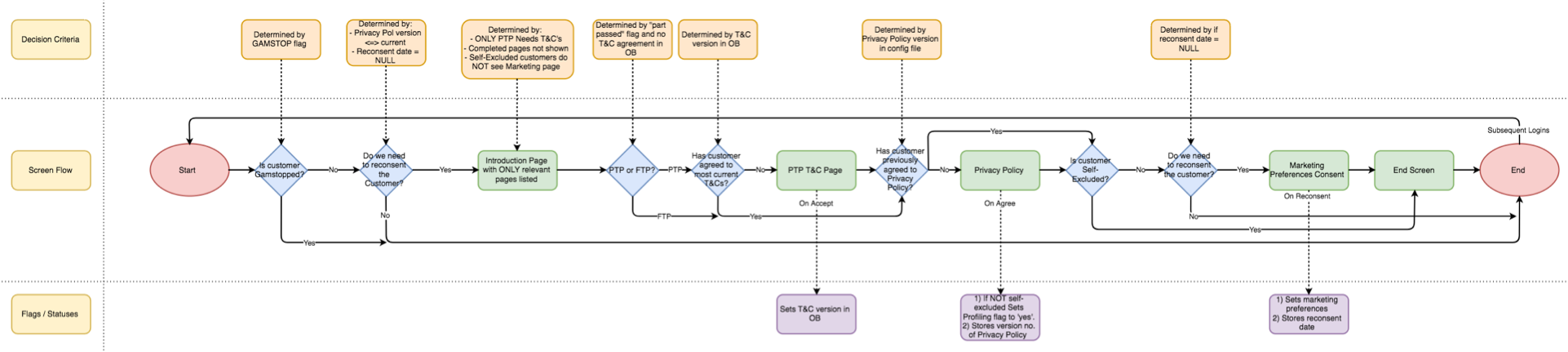
Working with the Developers, Business Analysts and Technical Architects we broke the flow down into three areas: decision criteria, screen flow, and flags & statuses.
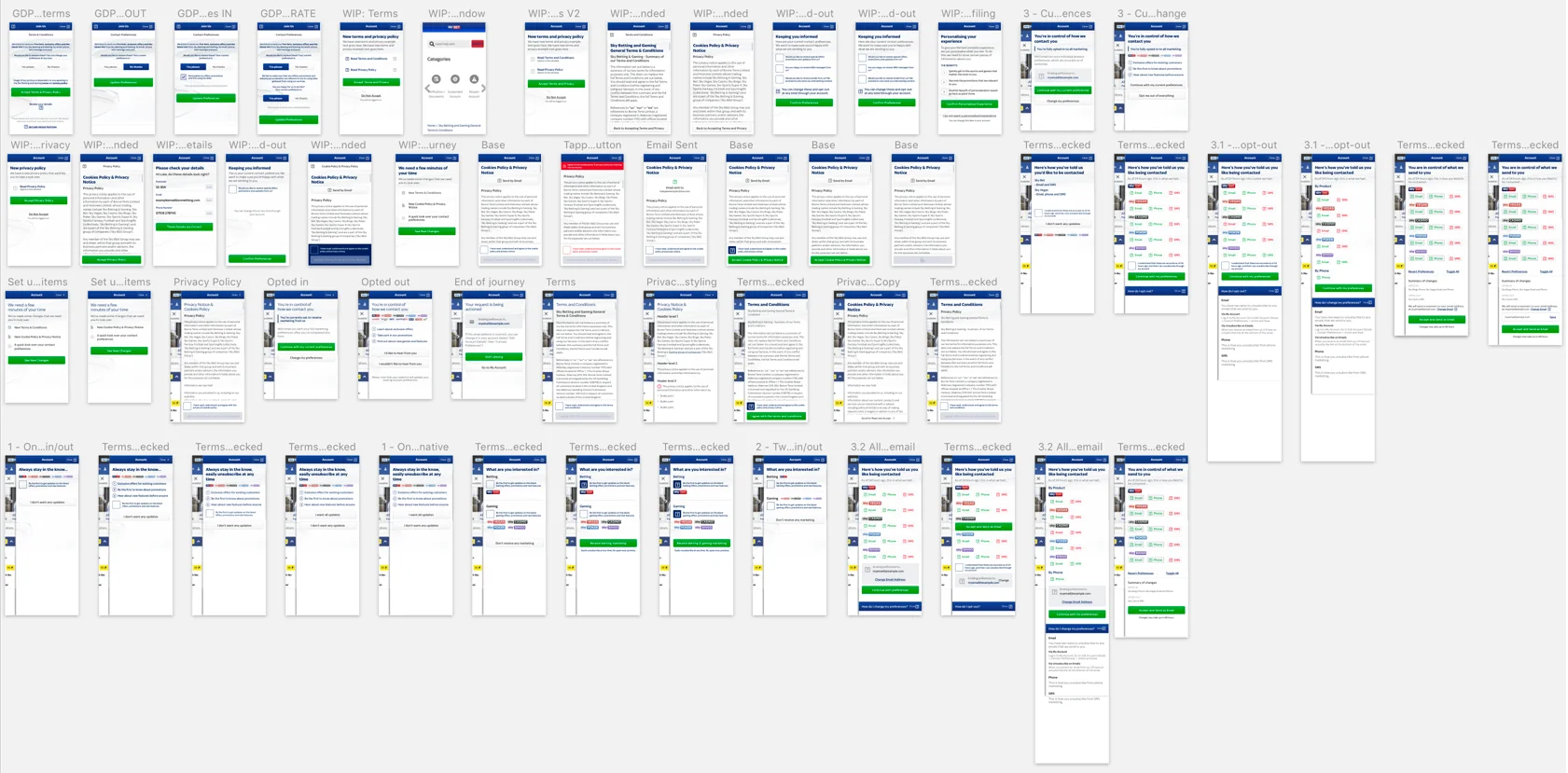
Experimenting with designs
After spending considerable time researching best practice for accepting agreements I began to develop ideas closely with the squad.
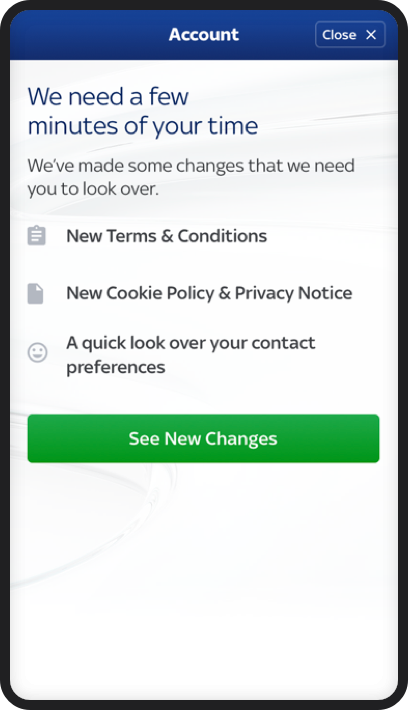
A 5 step process
When logging in the user would be presented with this screen. We needed to set them up for what was to come next and why.
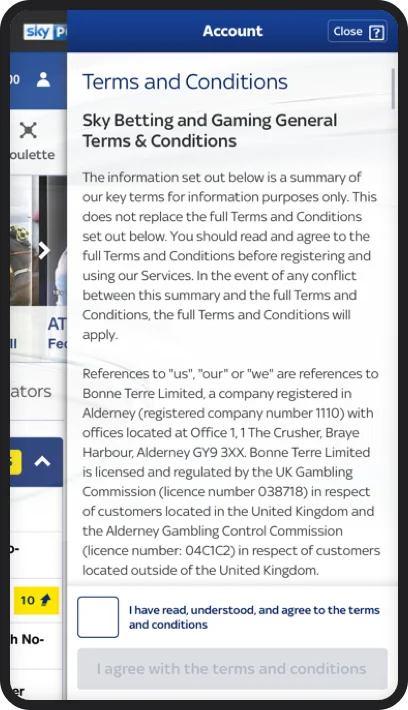
This page was pretty basic. A long list of terms and conditions. The user was able to accept the terms without needing to scroll through all of the paragraphs.
For legal reasons, the user must scroll through the entirety of the privacy policy before accepting it. We had to be as sure as we could be that they'd have read it. This brought a whole new set of design challenges. The acceptance box was at the end of the privacy policy on our initial design. More on iterations later.
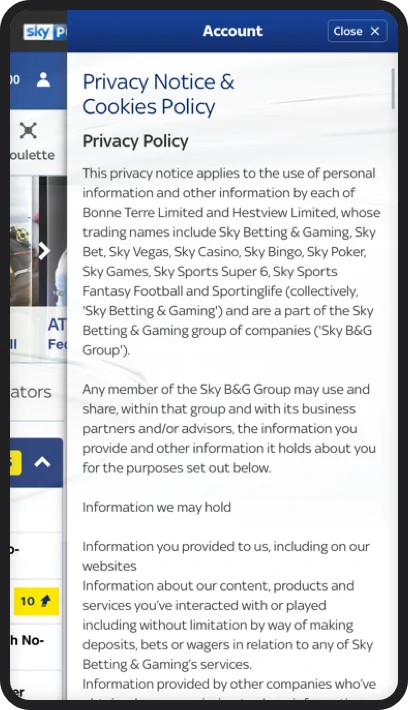
This is where most of my experimentation and design iterations happened. More detail on the variations below.
A chance for us to give the user a next best action, and to thank them for their time.
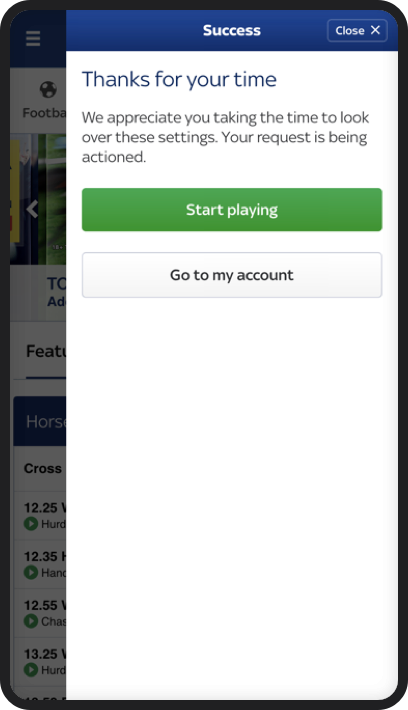
Design 1
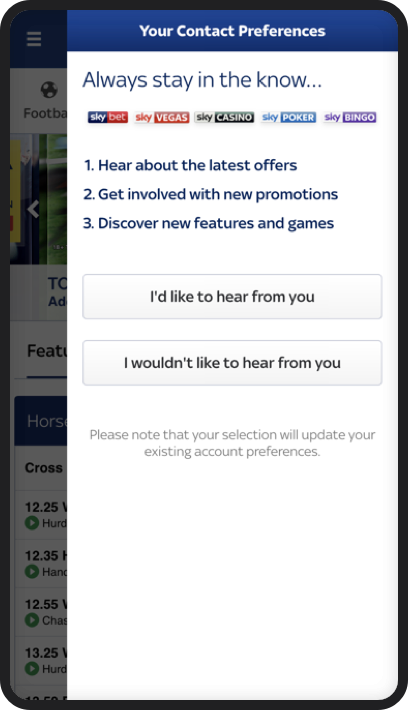
Theory
By giving the user reasons to receive marketing and by showing them the mixture of brands, they would be more likely to want to receive marketing content.
Design 2
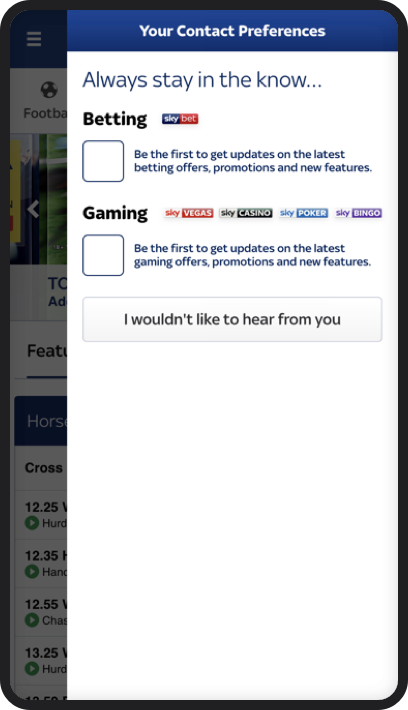
Theory
Users may only be interested in marketing from one kind of product. Either bet or gaming. This design gave them the granular option to select what they were interested in: bet, gaming, or both.
Design 3
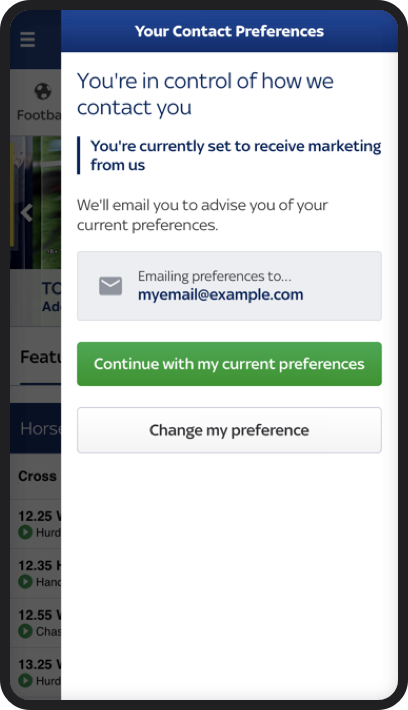
Theory
Users would be aware of their current marketing preference, and would prefer to just continue as they were.
Design 4
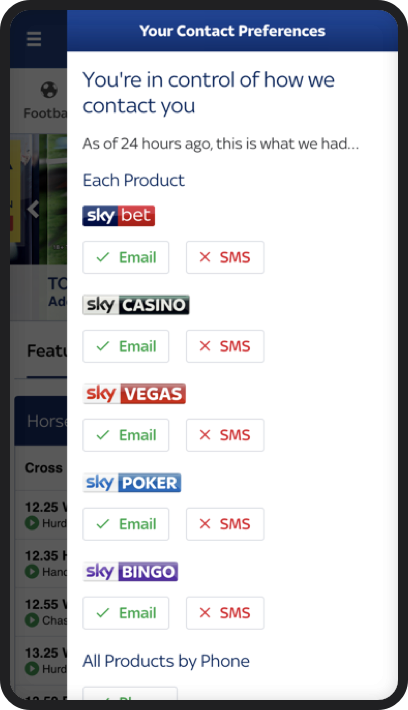
Theory
Giving the users a granular overview of their marketing preferences gave them total control. The assumption was that users given this amount of control would opt-in, but only to the products and channels that were of interest to them.
Having a click-through prototype for the data I needed wouldn't suffice. For this project, I needed to create an HTML prototype. I'd need to capture statistical data from 100s of users per design. I built the HTML prototype and embedded Google Analytics for the tracking. This prototype matched the exact look and feel of the real app, to be as close to a live experience as possible.
Each design had custom tagging. I was tracking which marketing preference each user-selected, how much as a percentage of the terms and privacy pages did users view, and any errors that users encountered. I set the randomisation of the user's current preference to match the current opt-in and out split; 65/35. I was also tracking whether users tapped on certain areas that I'd identified as potentially confusing. For example the list on step 1 showing each step. I wanted to know if users tried to tap on this.
The designs were finalised, the theories were laid out, the prototypes were built and we were ready to test. To ensure the tracking was working we ran a usability test with 6 users. This gave us valuable insight into the usability of the designs, but also allowed us to test to see if everything was working. These results represent testing with at least a 100 users per design.
Taking learnings from the usability tests and the 100s of user tests performed on each design, I created the 5th iteration to test.
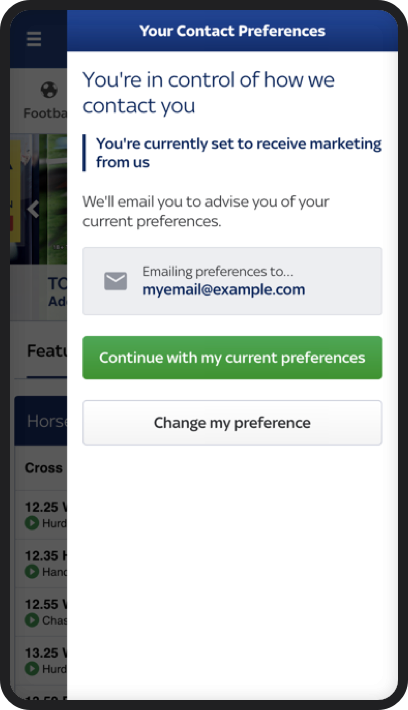
If the user is receiving marketing currently then they probably already know they are. This design made it easy for the user to carry on with that preference, or they could change it if they liked. There was very little reason to give them reasons to stay opted-in.
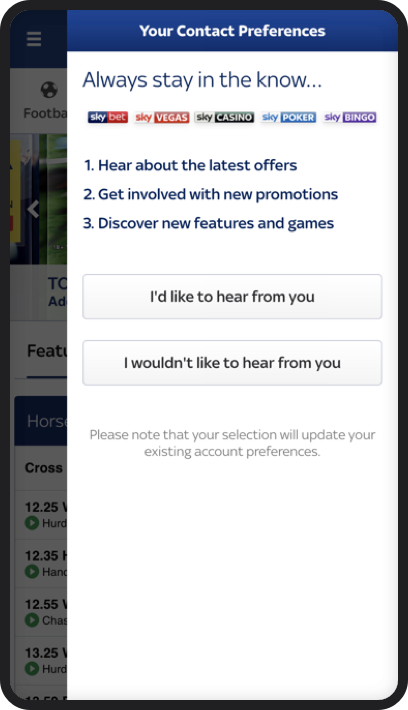
When the user was opted-out of marketing I wanted to give them reasons to opt-in. I listed 3 main reasons why you would want to do so and gave them the option to receive marketing or not.
04/ Outcomes
This success of this project was helped by the autonomy I had and the pre-allocated budget. I was able to hire participants, spend time on research and design, run multiple iterations and user tests and have my final design built. All of this with very little sign-off or intervention. I worked very closely with the legal and compliance teams to ensure what I was designing was inline with GDPR.
~ 3 million people completed overall
1.73 million people completed in the first week
600k people completed in 1 day alone
98% completed in the first session
When looking at all of the products combined the marketing preferences opt-in rate had a 1% point decrease. But this doesn't tell the whole story. Most of the people who opted-out of marketing were from the free-to-play products group, which had a much lower customer value. When looking purely at the pay-to-play products, the percentage of those opting-in to marketing increased.
The increase in the pay-to-play customer base was worth millions of pounds for every percentage increase, per year. Taking averages of the marketed-to customer group's value and multiplying this by the percentage increase yielded millions of pounds in profit per year.

The prototypes needed to capture data from 100s of users to be statistically significant. The best solution was to build the prototypes in HTML rather than as click-through images.

The testing gave us more than just figures on opt-in and out rates. I found areas that had usability issues, how many users encountered errors and scroll percentage on the legal steps.
Available from January 2027
Looking for a product, service or design systems leader?
I'm open to product design, service design, design systems and design leadership roles. Remote anywhere, or hybrid across the UK.